
Every week a contractor asks us some version of the same question: “What’s lumber running per square foot right now?” And every week the honest answer starts the same way — it depends on what’s in your walls — before we give them the number anyway. So here’s the number, and then the math underneath it, because the math is what keeps the number from burning you on a bid.
In August 2026, framing lumber and structural panels for a typical single-family home run $5.50 to $11.00 per square foot of floor area, materials only. Add engineered wood, trusses, and exterior wood products and the full wood package commonly lands between $8 and $16 per square foot. Simple production plans sit at the bottom of the range; custom homes with tall walls, big openings, and complicated roofs sit at the top — and sometimes above it.
Where the Market Is Right Now
Prices below reflect the national picture as of early August 2026:
- Framing lumber composite: $558 per thousand board feet (MBF) — up 2.1% over the past month, down 2.6% year over year (NAHB / Random Lengths, August 7, 2026)
- Canadian softwood tariff: 14.54%, adding roughly $60–$70/MBF to landed SPF costs — relevant because Canada supplies close to 30% of U.S. consumption
- OSB 7/16″ sheathing: roughly $14–$17 per 4×8 sheet at the yard, with regional swings
- LVL: around $2.80–$3.40 per lineal foot for common 1-3/4″ x 9-1/2″ stock
Two things about that composite number. First, it’s a mill-level benchmark — your yard price includes freight, handling, and margin, so don’t bid off the composite directly. Second, it moves. A package you priced in April at spring lows is stale by August, and on a 15,000 board-foot house, every $50/MBF move is $750 of margin appearing or disappearing between quote and purchase.
The Board-Foot Math Behind the Per-Square-Foot Number
A typical 2,200–2,500 sq ft two-story home consumes roughly 14,000 to 16,000 board feet of dimensional lumber, plus somewhere north of 6,800 square feet of OSB across roof, wall, and floor sheathing. Run the arithmetic:
| Component | Quantity (2,400 sq ft home) | Cost at Aug 2026 prices |
|---|---|---|
| Dimensional framing lumber | ~15,000 BF @ ~$470–$520/MBF delivered | $7,000 – $7,800 |
| OSB sheathing (roof/wall/floor) | ~215 sheets | $3,000 – $3,700 |
| Engineered wood (LVL, I-joists) | varies by design | $1,500 – $4,000 |
| Roof trusses (if trussed) | per truss design | $3,500 – $7,000 |
| Total wood package | — | $15,000 – $22,500 |
Divide by 2,400 square feet and you get $6.25–$9.40/sq ft for this fairly ordinary house — right in the middle of the national range. Your house will differ, which is precisely the point: per-square-foot averages are for budgeting, not bidding.
Why the Range Is So Wide: Six Multipliers
1. Stories and wall height
Nine- and ten-foot plates add board footage fast, and tall first-floor walls often trigger engineering upgrades — taller studs at tighter spacing, more blocking rows. Two homes with identical floor area can differ 15% on wall lumber from plate height alone.
2. Roof complexity
A simple trussed gable is the cheapest roof you can frame. Hips, valleys, dormers, and stick-framed sections push both board footage and labor. On cut roofs we regularly see the roof takeoff alone swing the package by $2–$3/sq ft.
3. Openings and structural loads
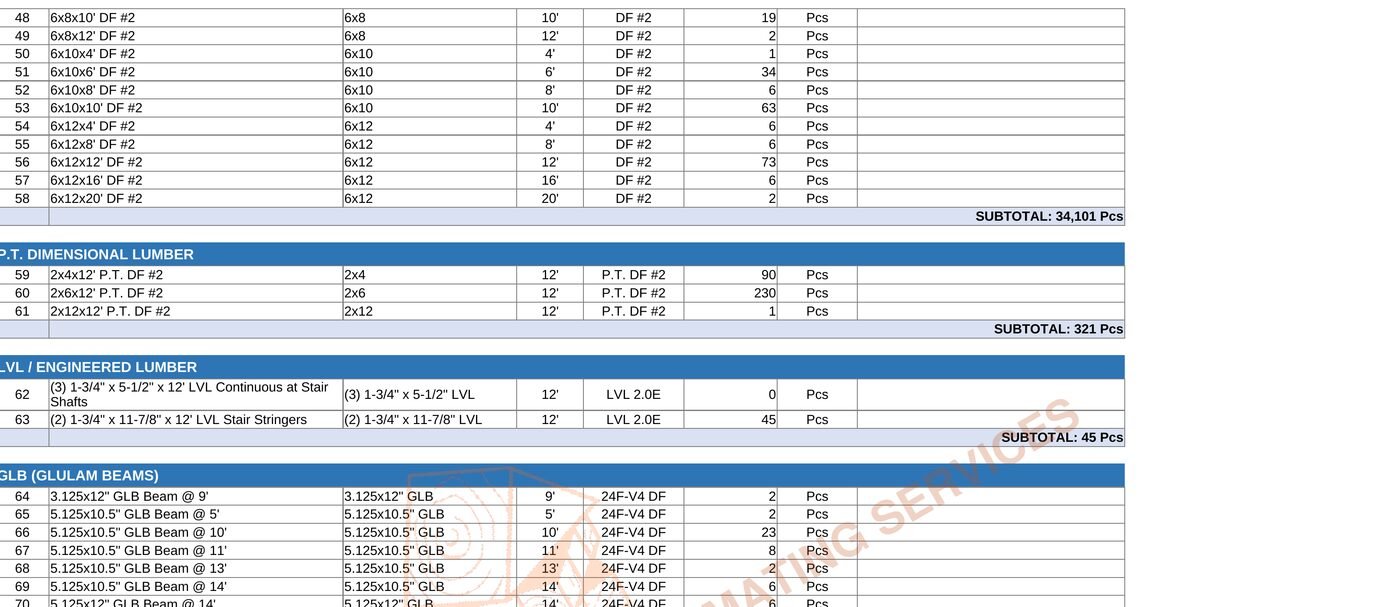
Every window and door means a header; big spans mean LVL or glulam instead of doubled 2x12s. On a recent three-story hotel project, the beam schedule ran from 3.125×12 glulams at 9 feet up to 5.125x18s at 25 feet — 85 beams total. No production-home average predicts that; the plans do.
4. Shear and seismic requirements
West Coast and high-wind projects carry shear wall schedules that add structural panels, hold-downs, extra studs at panel ends, and nailing you must count. One California skilled nursing facility we estimated needed 23,578 panel sheathing clips and 4,046 boxes of fasteners. That’s not a rounding error — it’s a line item worth thousands.
5. Species and grade
SPF, SYP, and Doug Fir don’t price the same. As of spring 2026, SYP 2x4s traded roughly $25–$50/MBF under comparable Doug Fir. Multiply a spread like that across 15,000 board feet and species selection alone moves a package by several hundred dollars.
6. Waste factor honesty
Industry-standard waste runs 10–15% depending on the material (NAHB guidance). A takeoff that shows waste as its own transparent line lets you tune it to your crew’s reality. One that buries padding inside inflated counts makes every future bid a little fatter than it needs to be — and you’ll never know by how much.
Turning a Per-Square-Foot Budget Into a Biddable Number
Here’s the workflow we recommend, and the one our own clients use:
- Feasibility stage: use $8–$16/sq ft (full wood package) to sanity-check a project before design is final. Averages are fine here.
- Bid stage: get a line-item takeoff from the actual plan set. This is where averages stop being safe — the spread between “average” and “your plans” is routinely 10–20%, which is more than most framing margins.
- Purchase stage: re-price the takeoff the week you buy. Quantities don’t change; prices do. An Excel takeoff with unit pricing columns makes this a ten-minute exercise instead of a redo.
That middle step is what we sell, so weigh our bias accordingly — but the numbers make the argument on their own. A framing takeoff from us starts at $150 and comes back in 24–48 hours as an editable Excel bill of materials, organized by floor and phase, waste shown separately. Against a $15,000–$22,000 package, it’s one percent to be sure the other ninety-nine are right. What a takeoff itself costs, and why, is covered in our 2026 takeoff pricing guide.
Regional Reality Check
National averages hide real spread. Freight to the mountain West, hurricane fastening schedules in the Gulf, seismic hardware in California, dense-urban delivery constraints in the Northeast — each nudges the per-square-foot figure. As a rough 2026 rule: Southeast markets tend to run 5–10% below national average on framing packages thanks to SYP proximity, while California and the Pacific Northwest run 5–15% above on the strength of code-driven hardware and Doug Fir pricing. If you bid across state lines, price each market from its own yards, not from your home market’s memory.
FAQ: Lumber Cost Per Square Foot
How much does framing lumber cost per square foot in 2026?
Materials only, $5.50–$11.00 per square foot of floor area for lumber and structural panels on typical residential construction; $8–$16 for the complete wood package including engineered wood and trusses. Framing labor is separate and varies more by market than materials do.
How many board feet of lumber does a house use?
Plan on roughly 6 to 6.5 board feet per square foot of floor area for conventional two-story construction — about 14,000–16,000 BF for a 2,200–2,500 sq ft home — plus sheathing, which is counted in square feet or sheets, not board feet.
Are lumber prices going up or down right now?
As of August 7, 2026, the framing composite sits at $558/MBF: up 2.1% on the month, down 2.6% on the year, with futures softening. Translation: mostly sideways with a slight summer firming. Check the week you buy; don’t bid August packages at April prices.
Can I just multiply square footage by a number and bid that?
For a budget conversation, sure. For a bid you have to build at that price — no. The gap between a per-square-foot average and a plan-specific takeoff is regularly larger than an entire framing margin. That’s not a scare line; it’s the reason estimating exists as a profession.
Bidding something this month? Send us the plans — PDF, CAD, or Revit — and get a line-item framing package back in 24–48 hours, priced to this week’s market. Or call (332) 242-5480 and talk it through first.