
No contractor has ever called us because a takeoff went wrong in an interesting way. It’s always the same story with different numbers: the bid felt tight, the job got won, and then somewhere between the first lumber drop and the roof sheathing, the math started leaking. A unit here. A missed hardware schedule there. By closeout, a job bid at 12% margin paid out at 4%, and nobody could point to the single moment it happened — because there wasn’t one. Bad takeoffs don’t explode. They bleed.
This article follows the bleeding, line by line, with numbers you can check against your own jobs. Fair warning: we sell takeoffs, so we have a horse in this race. The arithmetic, though, doesn’t care who’s doing it.
The Two Ways a Takeoff Goes Bad
Every takeoff error is one of two kinds, and they cost differently.
Over-counting: the quiet tax
Padding feels safe. “Order heavy, we’ll use it somewhere.” On a 2,400 sq ft house consuming ~15,000 board feet, a 7% pad at today’s ~$500/MBF delivered is roughly $550 of excess lumber, plus $200–$400 in surplus sheathing and engineered stock. Some of it gets returned at a restocking fee. Some becomes blocking. A surprising amount rides around in trucks until it warps, then goes in the dumpster you also paid for.
Call it $600–$1,200 per house. Build twenty houses a year on padded numbers and you’ve quietly donated $12,000–$24,000 to the scrap pile. But the bid-table cost is worse: your padded material number is baked into every price you submit. Against a competitor bidding from measured quantities, you’re 2–4% high on materials before anyone sharpens a pencil. You don’t lose those bids loudly. You just lose them.
Under-counting: the loud one
Now run it the other direction, because this is where margins actually die. Say the takeoff missed 6% of the package — a header schedule read wrong, a floor’s worth of rim board, the second layer of shear panel on two walls. The chain reaction, at 2026 prices:
| Cost Link | What Happens | Typical Hit (single house) |
|---|---|---|
| Spot-market repurchase | You buy the missing 900 BF at yard walk-in pricing, not your negotiated package rate | $450–$700 |
| Broken-load delivery | Two or three small hotshot deliveries instead of one drop | $150–$400 |
| Crew downtime | A 4-person framing crew at ~$65/hr loaded, waiting half a day for material | $1,000–$1,300 |
| Schedule slip | Framing inspection pushed, trades resequenced, super’s week rearranged | $500–$2,000 |
| Substitution compromises | Wrong lengths ripped down, #2 where you wanted select, LVL “close enough” | Waste + callback risk |
Total: $2,100–$4,400 on one house, from one 6% miss. On a job carrying maybe $8,000–$12,000 of framing margin, you just handed back a quarter to half of it — and that’s the version where nothing goes to rework.
The Misses That Do the Most Damage
After hundreds of takeoff reviews, the expensive misses are rarely studs and plates. Estimators get walls right. The margin-killers hide in the supporting cast:
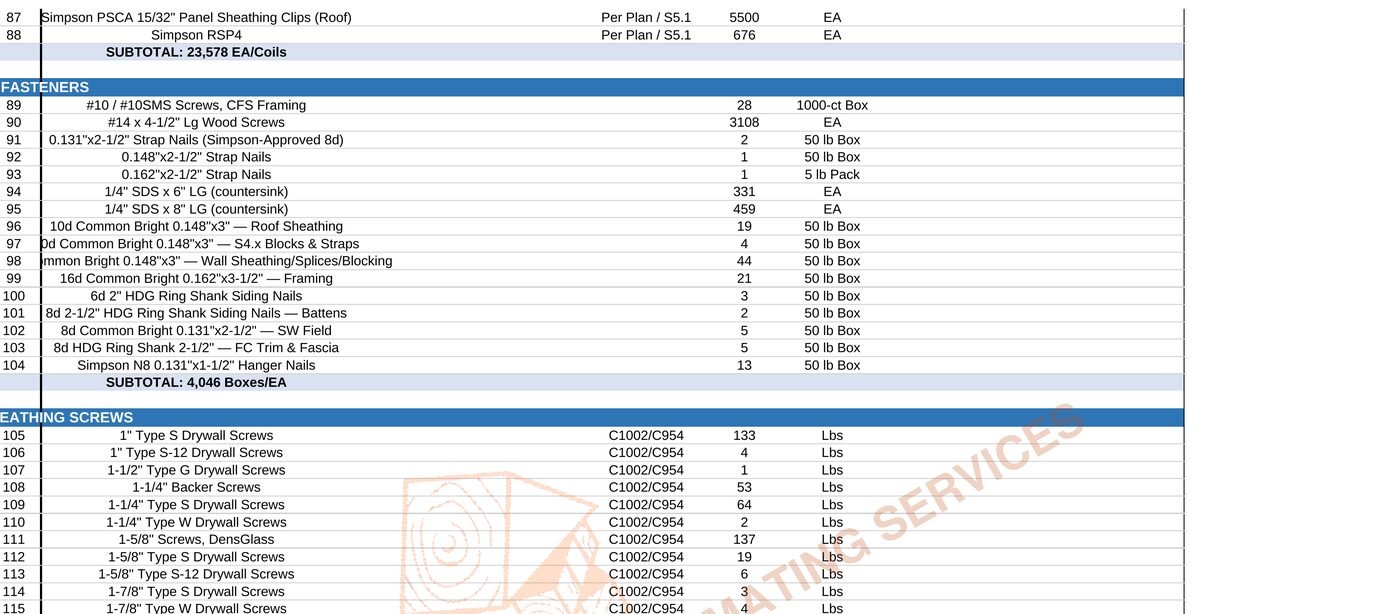
- Hardware and fasteners. The least glamorous line items and the most-skipped. On one skilled nursing facility we estimated, the connector and fastener schedule ran to 23,578 sheathing clips, 4,046 boxes of nails and screws across 18 types, and 607 pounds of drywall screws. A takeoff that waves at this with a “hardware allowance” is hiding four figures of real cost.
- Blocking, backing, and draftstopping. Invisible on floor plans, mandatory at inspection. Fire blocking in tall walls, backing for cabinets and rails, shear transfer blocking — the stuff that gets framed twice: once in lumber, once in change-order paperwork.
- Pressure-treated transitions. Sills, ledgers, anything touching concrete. Miss the PT line and someone’s driving to the yard Saturday morning, buying it at retail.
- Shear wall extras. End studs at panels, extra rows of nailing, hold-down posts. On engineered West Coast jobs the shear schedule is its own economy; we itemize it wall by wall — SW1 through SW16 on a recent hotel — because lump-summing it is how it gets missed.
- Waste factor fiction. A flat 10% on everything is wrong twice: too much on studs (real-world cut waste is lower on repetitive walls), too little on sheathing over complex roofs. NAHB-standard practice runs 10–15% varied by material, and the variance is the point.
The Compounding You Don’t See: Reputation Math
The jobsite costs are countable. The slower damage is what a shaky number does to how you’re perceived. GCs remember whose framing bids hold and whose grow change orders; lumberyards remember whose orders come back clean and whose come back in five corrections. In a market where the framing composite moved 2.1% in a month, buyers are already nervous about price — a contractor whose quantities they trust is the one who gets the “can you hold this number?” call instead of the re-bid. Contractors bidding from professional estimates in our client base report win-rate improvements up to 34%; some of that is speed, but a lot of it is that verifiable numbers read as competence.
What Defensible Quantities Cost vs. What They Prevent
A professional residential takeoff runs $150–$500 (full pricing breakdown here). One prevented under-count pays for 5–15 of them; one un-padded bid that wins pays for a year of them. The takeoff isn’t the expensive part of estimating. The mistake is.
What makes a takeoff defensible rather than merely present:
- Line items, not lumps. “6×12 DF #2 @ 12′ — 73 pcs,” not “beams.” Lumps are where misses hide.
- Marked-up plans. Every quantity traceable to a colored markup on the drawing. When a framer says “we’re short,” you settle it with the markup in five minutes, not a re-measure over the weekend.
- Waste shown separately, varied by material. So you can tune it to your crew rather than inherit someone’s fiction.
- A second set of eyes. QC review before delivery. Solo-checked numbers — in-house or outsourced — drift. (How accuracy is actually measured and verified is its own article: Is 98% Accuracy Real?)
A 15-Minute Audit for the Takeoff You’re About to Bid
Whoever produced your current takeoff, run this before the number goes out the door:
- Is there a hardware/fastener section with actual counts — or an “allowance”?
- Is PT lumber a separate, complete section (sills, ledgers, posts, anything at concrete)?
- Do shear walls carry their extra studs, posts, and panel layers — itemized?
- Is blocking/backing/draftstopping present as line items?
- Is waste a visible percentage per material — or invisible?
- Can every big-ticket line (beams, trusses, LVL) be traced to a plan location?
Two or more “no” answers means the number you’re about to bid contains a surprise, and surprises on jobsites only ever point one direction.
If you’d rather not find out mid-job: send us the plans — takeoffs from $150, delivered in 24–48 hours with marked-up plans and itemized hardware, free revisions within 48 hours. Or start by scrolling a real sample takeoff and comparing it to what you’re bidding from today.