
Browse five estimating websites and you’ll find the same number on four of them: 98%. We publish it too. And if you’ve ever wondered whether that number means anything — or whether it’s the estimating industry’s version of “9 out of 10 dentists” — this article is the straight answer, including the parts that don’t flatter anyone in our business.
Short version: 98% is achievable, measurable, and — from a disciplined shop — real. It is also routinely quoted by providers who couldn’t tell you what it’s 98% of. The difference between those two situations is auditability, and by the end of this piece you’ll be able to test any provider’s number yourself, ours included.
What “98% Accurate” Actually Claims
An accuracy figure is meaningless until three questions are answered:
1. Accurate against what baseline?
The honest baseline is the plans: do the takeoff quantities match what the drawings, schedules, and details require? That’s what an estimator controls. A takeoff can be plan-perfect and the job can still consume different material — because the framer cut generously, the design changed, or the plans themselves were wrong. Field variance measures your whole project; takeoff accuracy measures the measuring. Providers who blur the two are borrowing credit or dodging blame, depending on the week.
2. Accurate in what units?
The meaningful measure is dollar-weighted quantity variance: the cost of items over- or under-counted, as a share of package value. Piece-count accuracy flatters everyone — get 4,000 studs right and miss 12 glulams, and you’re “99.7% accurate” by count while being wrong by $9,000. When we say 98%, we mean the deliverable’s quantities, priced, land within 2% of a verified measurement of the same plans. That’s the definition worth demanding from anyone.
3. Verified by whom?
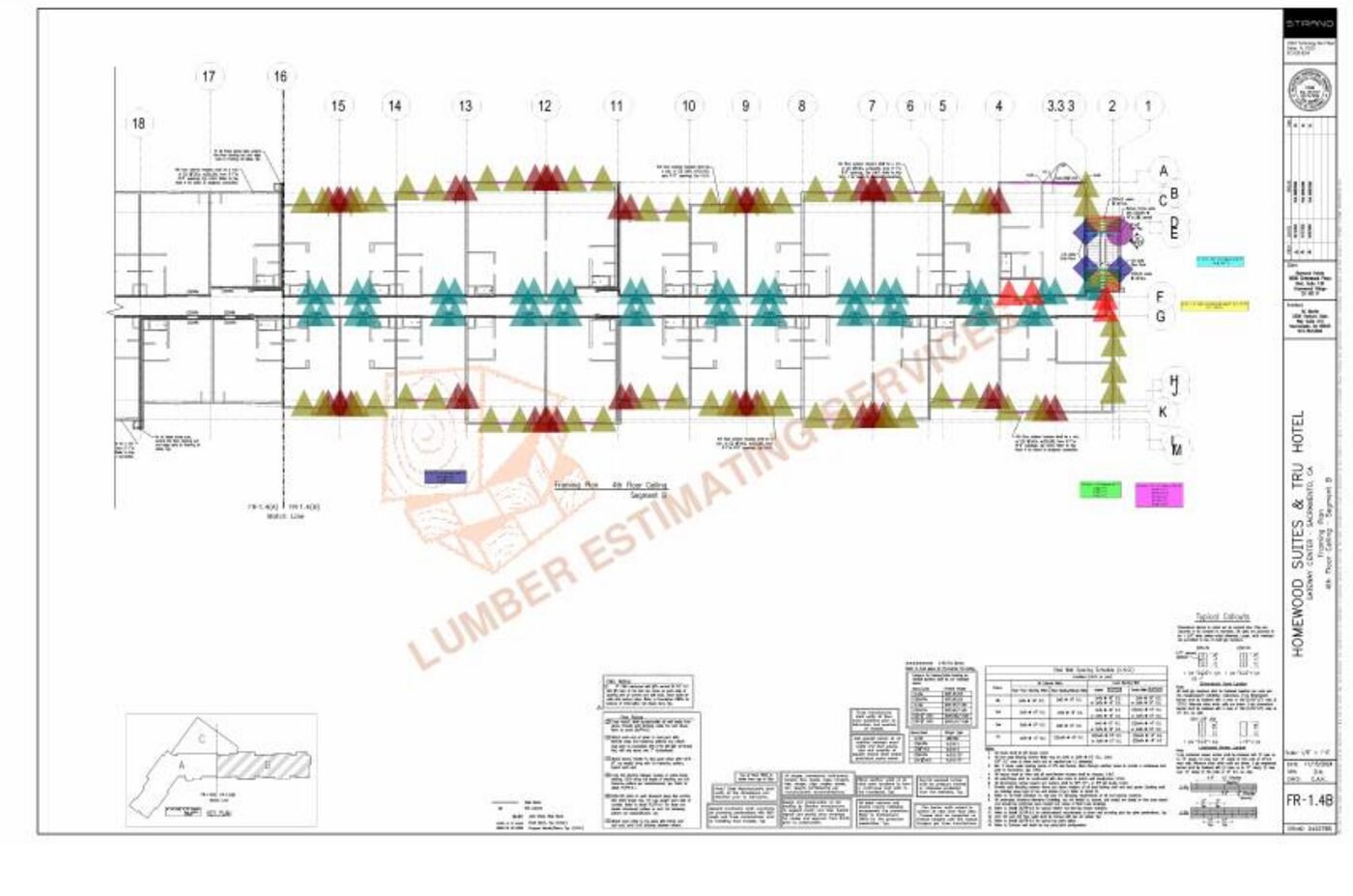
A number nobody checks is a slogan. Internally, verification means second-estimator QC review before delivery and reconciliation when clients or yards flag discrepancies. Externally — and this is the part you control — verification means the deliverable ships with the evidence needed to audit it: color-coded plan markups tracing every quantity to the drawing. A provider claiming 98% while delivering unmarked spreadsheets is claiming a number that cannot be checked, which is a strange kind of confidence.
Where the Missing 2% Lives
Perfect takeoffs don’t exist, and the reasons are structural, not shameful:
- Plan ambiguity. Drawings conflict — the architectural says one thing, the structural another, the schedule a third. The estimator resolves it, notes the assumption, and is sometimes resolved against by Addendum 3. On a recent hotel project our wall schedules tracked sixteen distinct shear wall types across three floors; when a revision reshuffles two of them, quantities move through no one’s error.
- Judgment items. Blocking and backing quantities depend on crew practice as much as drawings. Two excellent estimators will land within a few percent of each other here — not at zero.
- Waste reality. The 10–15% NAHB-style waste range is a professional estimate of a jobsite behavior, and jobsites have personalities. This is exactly why waste must be visible and tunable rather than hidden — it’s the least “accurate” number in any takeoff, by nature.
What separates disciplined shops isn’t the absence of that 2% — it’s where they let it sit. The professional bias: dead-on for the big-ticket, engineered, per-stick items (beams, LVL, trusses, hardware models), with the honest uncertainty confined to tunable, cheap, judgment categories. The amateur bias is the reverse, and it’s expensive: here’s what the reverse costs.
How to Verify Any Provider’s Accuracy in 20 Minutes
Don’t argue with claims. Audit one deliverable:
- Pick five line items by dollar value, not at random. The two biggest beams, the truss count, a shear wall’s panel layers, the PT sill line.
- Trace each to the markup. Find the colored measurement on the plans. Can’t find it? That’s your answer already.
- Re-measure one wall run and one sheathing area yourself. Scale off the drawings; compare. You’re not checking to the hundredth — you’re checking whether the takeoff and the plans describe the same building.
- Check the boring sections exist. Hardware counted (not allowanced), PT separate, waste visible. Accuracy fails silently in missing sections far more often than in mismeasured ones — the full anatomy is in our deliverables checklist.
- Ask what happens when you find an error. The professional answer is a process: verify against markups, correct, redeliver — free within a stated window (ours: 48 hours). The amateur answer is an adjective.
Run that audit on a $150–$300 test project before committing a pipeline to anyone — it’s the same one-project test we recommend in the vetting guide, with a magnifying glass added.
Why Accuracy Compounds Into Money
The reason to care isn’t pride of measurement. At August 2026 prices — framing composite at $558/MBF, up 2.1% on the month — a 2% quantity error on a $15,000–$22,000 single-family wood package is $300–$450 of exposure; a 6% error is $2,000–$4,400 once the jobsite chain reaction is counted. Scale to a hotel package with 34,101 pieces of dimensional lumber and 1,610 floor trusses, and the same percentages are the difference between a profitable building and an awkward conversation with your lender. Accuracy percentage points aren’t a marketing decimal. They’re your margin, expressed as a ratio.
And the commercial upside runs the same direction: contractors bidding from tight, verifiable quantities submit faster and defend numbers better — our clients report bid acceptance improvements up to 34% after switching to professional estimates. Buyers can’t see your takeoff, but they can feel it in how your number holds under questioning.
The Honest Summary
98% accuracy is real when it means: dollar-weighted quantity variance under 2% against the plan set, produced under second-person QC, delivered with markups that let you check it, and backed by a stated correction process. It’s a slogan when any of those four clauses is missing. Every provider — again, us included — should be happy to put their number in that sentence. The ones who aren’t have told you their real number.
Audit us first, buy second: start with the sample takeoff, then send one live plan set — from $150, 24–48 hours, markups included, free revisions within 48 hours. Questions to (332) 242-5480.