
Every takeoff website says the same three things: accurate, fast, affordable. Ours says them too. Which means the websites can’t help you choose — the vetting has to happen in the questions you ask before the first dollar moves. The good news: twelve questions, one phone call or email, and the weak providers eliminate themselves. We’ve included what a good answer sounds like for each, and where the trap is.
Yes, we’re a takeoff service telling you how to shop for takeoff services. We can live with the conflict of interest because we answer all twelve happily — and because clients who ask hard questions upfront are the easiest clients to keep for years.
The 12 Questions
1. “Can I see a full sample takeoff for my project type?”
Good answer: a complete, real (redacted or watermarked) deliverable — every page, not a screenshot of the pretty summary. Here’s ours.
Trap: “We’ll show you after you order.” A provider whose best work can’t be shown in advance is telling you something.
2. “Do you deliver marked-up plans with the quantities?”
Good answer: yes, always — color-coded markups showing exactly what was measured where, so every number is auditable against the drawings.
Trap: spreadsheet-only delivery. Without markups you can’t verify anything; you’re buying trust, not evidence. This single question eliminates more weak providers than the other eleven combined.
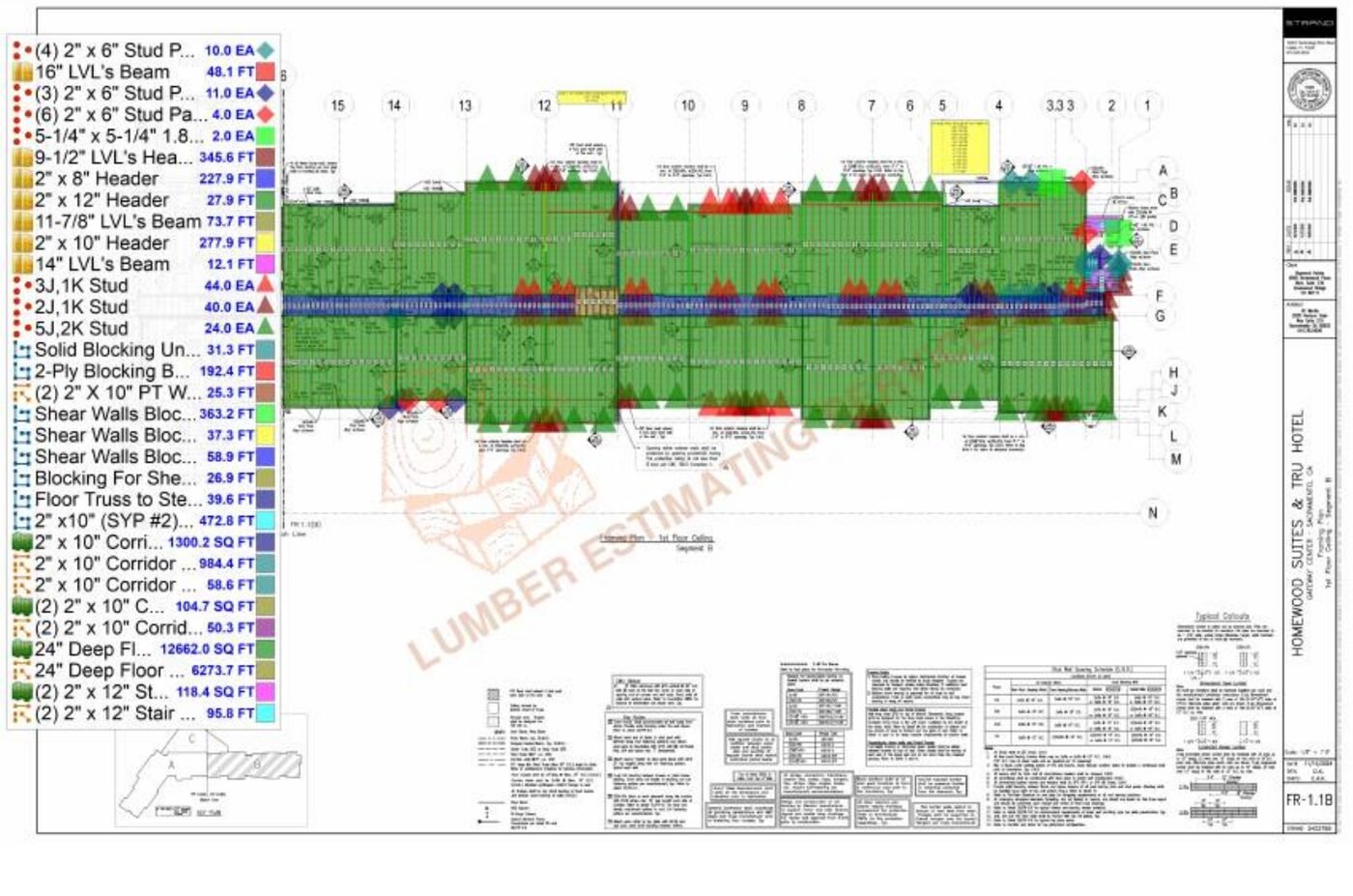
3. “What exactly is in scope for this price — in writing?”
Good answer: an itemized scope list: walls, floors, roof, sheathing, posts & beams, PT, engineered wood, hardware — each marked in or out.
Trap: “full framing takeoff” with no definition. That phrase has as many meanings as there are providers, and the gaps surface as invoices or jobsite shortages. (What complete scope looks like: our deliverables checklist.)
4. “Who actually performs the takeoff, and what’s your QC process?”
Good answer: named process — estimator produces, a second person reviews before delivery, software named (PlanSwift, Bluebeam, On-Screen Takeoff are the standards).
Trap: vagueness about whether a human reviews anything, or a one-person shop claiming same-day turnaround on everything — both mean no second set of eyes. Unreviewed numbers drift; it’s not a character flaw, it’s arithmetic.
5. “What are your waste factors, and are they shown separately?”
Good answer: NAHB-aligned 10–15% varied by material, visible as its own line so you can adjust to your crew.
Trap: “waste is built in.” Built in where, at what rate? Invisible padding makes every future bid quietly fatter and makes the takeoff impossible to audit.
6. “What’s your revision policy when plans change?”
Good answer: a stated window and price — e.g., free revisions within 48 hours of delivery, addendum updates quoted promptly.
Trap: no policy until you need one. Addenda aren’t an edge case in construction; a provider without a revision policy hasn’t done much construction.
7. “How do you learn and keep my preferences?”
Good answer: a client spec sheet — your species and grade preferences, stocking lengths your yard carries, how you like counts organized (by floor, by phase, by building) — written down and applied to every job.
Trap: “just tell the estimator each time.” Rotating estimators with no documented preferences means takeoff #6 repeats the mistakes of takeoff #1.
8. “What file formats do you accept and deliver?”
Good answer: accepts PDF, DWG/DXF, Revit, even scanned drawings; delivers editable Excel/CSV plus PDF.
Trap: locked-PDF-only delivery. If you can’t sort, re-price, or hand the file to your yard, the takeoff is a picture of a takeoff.
9. “What’s the turnaround — as a date, against my bid date?”
Good answer: a commitment: 24–48 hours residential, 3–5 days commercial, rush available at a stated surcharge (+25–35% is market; ours is +30%).
Trap: “usually pretty fast.” Your bid date is a hard date; the turnaround should be one too.
10. “Can you price the takeoff at current market, and how current?”
Good answer: yes, with a source and date — e.g., composite/RS Means-referenced pricing applied the week of delivery. With framing lumber at $558/MBF and moving ~2% in a month, “priced in spring” is a real liability.
Trap: pricing with no date attached, or quantities-only when you asked for priced — find out which product you’re buying before you compare quotes. (Model-level pricing differences are covered in our pricing models guide.)
11. “Have you done my project type — and can you prove it?”
Good answer: portfolio evidence at your scale. Hotels, multifamily, custom homes, and commercial each have their own failure modes (corridor framing, shear schedules, cut roofs, prevailing-wage paperwork); a provider should show work at yours — here’s our portfolio.
Trap: “we do everything.” Everyone says it; the portfolio either exists or it doesn’t.
12. “What happens if you’re wrong?”
Good answer: a straight one — how errors get verified against the markups, corrected, and made right. Accuracy claims (98% is the industry’s favorite number) should come with an explanation of what’s being measured; we wrote that explanation up honestly in Is 98% Accuracy Real?
Trap: either bluster (“we’re never wrong”) or fine print (“estimates are advisory only” doing an enormous amount of legal work). Everyone who measures for a living is occasionally wrong; the process for when it happens is what you’re vetting.
Scoring the Answers
You don’t need a rubric — the pattern is unmistakable. Strong providers answer all twelve fast, in writing, without being chased, because the answers are just descriptions of how they already work. Weak providers get vague at exactly four points: samples, markups, QC, and what-if-you’re-wrong. Those four are the product; everything else is packaging. A provider can be forgiven a clunky website or a slow email — not a missing markup.
Price, notably, isn’t one of the twelve. Not because it doesn’t matter — it does, and here’s the market — but because price only becomes comparable after scope is pinned down, and because the cheapest quote failing three of these questions is the most expensive option on the table (here’s that math). If a quote seems too cheap to survive these questions, it usually is — the specific patterns are catalogued in Red Flags in a Lumber Takeoff Quote.
The One-Project Test
After the questions, don’t award your whole pipeline. Send one live project — a real bid with a real date — and score the experience: Was the quote same-day? Did the deliverable match the sample? Did the markups let you spot-check three quantities in five minutes? Did anyone ask smart questions about your plans? A $150–$300 test tells you more than any reference call, and a good provider knows the first project is the audition.
We’ll take that audition any day: send one plan set — free quote, usually same day, takeoff in 24–48 hours with full markups. Ask us all twelve questions at (332) 242-5480; we like clients who arrive with the list.