
Ask five takeoff providers for a quote and you may get five different pricing structures before you ever get to the number: a flat rate, a per-square-foot rate, a per-sheet rate, an hourly rate, and a monthly subscription. They can all land on a fair price. They distribute risk completely differently — and the model that saves one contractor money costs another one plenty.
Here’s how each model actually behaves once real projects hit it, and how to pick the right one for the way you bid.
The Five Pricing Models, Stress-Tested
1. Flat rate per project
How it works: provider reviews your plans, quotes one fixed number for a stated scope. Ours start at $150 residential / $300 commercial.
Where it wins: certainty. The price can’t grow mid-takeoff, complexity risk sits with the estimator who priced it, and comparing providers is clean because each quote is a scope with a number attached. It also rewards good plan sets — send complete documents and you’ll consistently quote at the low end.
Where it strains: flat pricing needs your plans first. Any provider offering a firm flat rate sight-unseen is either padding every quote to cover their blind spots (you overpay on simple jobs) or planning to renegotiate when they open the drawings (the “flat” was marketing). Sight-unseen flat pricing is red flag #4 in our takeoff quote red flags guide.
2. Per square foot
How it works: a rate — commonly a few cents to ~15¢/sq ft depending on scope — times the project’s floor area.
Where it wins: predictability at volume. Builders running dozens of similar plans can budget estimating as a per-unit cost that scales linearly. Easy to compare, easy to forecast.
Where it strains: square footage is a bad proxy for estimating effort. A 5,000 sq ft rectangle with trusses is less work than a 2,800 sq ft custom with three plate heights and a cut roof — per-square-foot pricing charges you as if the opposite were true. It also invites quiet scope games: is the garage in the square footage? Covered porches? The provider and you may be multiplying different numbers. If you use this model, get the area basis in writing.
3. Per sheet of drawings
How it works: a rate per plan sheet measured.
Honestly: this model mostly benefits the provider. Sheet count correlates with document formatting, not estimating effort — one architect puts on four sheets what another spreads across eleven. We’d pass, unless the per-sheet number is trivially low and the scope is crystal clear.
4. Hourly
How it works: $35–$75/hr for takeoff work, billed as spent.
Where it wins: genuinely open-ended work — change-order re-measures, forensic quantity disputes, value-engineering studies where nobody can scope the finish line in advance.
Where it strains: everywhere else. For a defined takeoff, hourly billing moves all efficiency risk onto you: the slower the work, the bigger the invoice. If a provider insists on hourly for a standard framing takeoff, ask why they can’t scope their own trade.
5. Monthly subscription / dedicated bid manager
How it works: a flat monthly fee — ours is $1,500 — for a dedicated estimator or coordinator covering your bid pipeline.
Where it wins: volume and consistency. Above roughly 8 takeoffs a month, the per-project math crosses over, and you get the thing per-project pricing can’t sell: one person who learns your waste factors, your yards, your species preferences, and applies them to everything. It converts estimating from a per-bid purchase into infrastructure — the same logic as the in-house vs. outsourced decision, one notch down the cost curve.
Where it strains: below ~5 takeoffs a month you’re buying capacity you don’t use. Buy per-project until your volume argues otherwise; any honest provider will tell you which side of the line you’re on.
The Same Three Jobs Under Each Model
Numbers below use typical 2026 market rates; your quotes will vary, the pattern won’t.
| Project | Flat Rate | Per Sq Ft (@8¢) | Hourly (@$50) |
|---|---|---|---|
| 4,600 sq ft simple production plan, trussed | $200 | $368 | $250–$350 |
| 2,800 sq ft custom, cut roof, tall walls | $450 | $224 | $500–$800 |
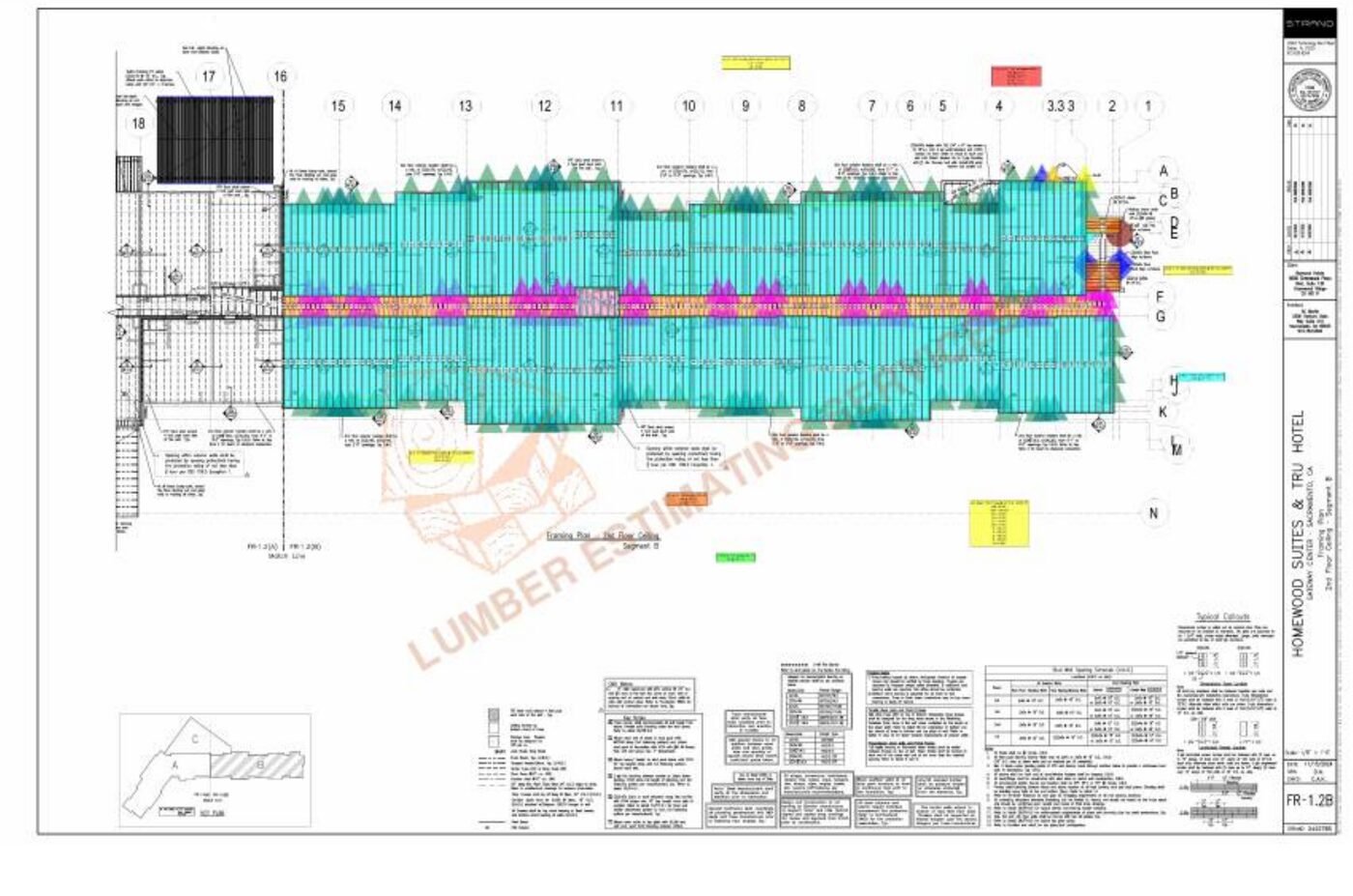
| 3-story hotel floor, repetitive units | quoted (~$2,500) | varies wildly by area basis | open-ended |
Read the first two rows against each other — that’s the whole argument. Per-square-foot overcharges the simple job and undercharges the complex one, which sounds like it averages out until you realize what it does to provider incentives: under per-square-foot pricing, your complex custom home is the job the estimator loses money on, and rushed work follows losing jobs around. Flat pricing set from the actual plans aligns the incentive: the estimator priced this job, knowingly, and owns the effort it takes.
So Which Model Should You Choose?
- Bidding occasionally, projects vary: flat rate per project, quoted from plans. Maximum certainty, cleanest comparisons.
- Production builder, repetitive plans: flat rate with a plan-library arrangement (base plan priced once, options and reverses cheap) — usually beats per-square-foot on the same portfolio.
- High-volume bidder, 8+ takeoffs/month: subscription. Below that, stay per-project.
- Disputes, re-measures, VE studies: hourly, capped with a not-to-exceed.
- Per sheet: we struggle to construct the contractor who benefits. Skip it.
Three Contract Details That Matter More Than the Model
- Scope in writing. Framing, sheathing, hardware, PT, engineered wood — listed. Most billing disputes are scope disputes wearing a costume. (What full scope looks like: our deliverables checklist.)
- Revision policy in writing. Addenda are a certainty, not a risk. Ours: free within 48 hours of delivery. Whatever your provider’s policy, get it before the first addendum, not after.
- Rush pricing in writing. Standard is +25–35% under 24 hours (ours: +30%). Knowing the number in advance turns a panic into a line item.
Model preferences aside, what you should pay in absolute dollars is covered in our 2026 takeoff pricing guide, and framing-specific pricing by project type is in the framing takeoff pricing guide.
Our own answer, for the record: flat rates from real plans — from $150 residential, $300 commercial, $1,500/month for a dedicated bid manager at volume. Send a plan set and see where yours lands; the quote costs nothing and usually comes back same day.