
At some point every growing contractor has this conversation, usually at 9pm over a plan set that should have been measured last week: “We need to hire an estimator.” Maybe. But “we’re drowning in takeoffs” and “we should add $95,000 of annual payroll” are two different problems, and most contractors jump from the first to the second without running the numbers in between.
We run takeoffs for a living, so you know where our bread is buttered. We’re also going to show you the honest version of the math — including the volume point where hiring in-house genuinely wins — because contractors who trust the math stay clients for years, and contractors sold a fantasy don’t.
The True Cost of a Full-Time Estimator
The salary is the visible number. It is not the number.
| Line Item | Annual Cost (2026, mid-market US) |
|---|---|
| Base salary — experienced lumber/framing estimator | $65,000 – $85,000 |
| Payroll taxes, insurance, benefits (~25–30%) | $16,000 – $25,000 |
| Takeoff software (PlanSwift, Bluebeam, OST licenses) | $1,500 – $3,500 |
| Hardware, dual monitors, plan storage | $1,000 – $2,000 |
| Recruiting / onboarding (amortized) | $3,000 – $8,000 |
| Loaded annual cost | $86,500 – $123,500 |
Call it $95,000–$110,000 a year, all-in, for one good person. And “one good person” is doing real work in that chair — but the chair has three structural problems that have nothing to do with the person sitting in it.
Problem 1: Lumpy demand, fixed cost
Bid flow isn’t flat. You’ll have weeks with six plan sets stacked up and weeks with one. The salary doesn’t flex. Across a year, most small-to-mid contractors keep a full-time estimator genuinely productive 55–70% of the time — you’re paying twelve months for seven or eight months of estimating.
Problem 2: One person is a single point of failure
Vacation, illness, a resignation two days before a bid date — a one-person estimating department has no redundancy. The week your estimator leaves is, with grim reliability, the week three good ITBs arrive.
Problem 3: One person has one set of eyes
Nobody checks the checker. Solo estimators develop habits — a pet waste factor, a species assumption, a way of reading shear schedules — and habits drift. Estimating firms live and die on internal QC precisely because unreviewed takeoffs go wrong quietly.
The True Cost of Outsourcing the Same Year of Work
Take a contractor bidding 2–3 framing jobs a week — call it 120 takeoffs a year, a genuinely busy pipeline that would fully occupy an in-house estimator.
| Scenario | Volume | Annual Cost |
|---|---|---|
| Light bidder (per-project @ $150–$300) | 20 takeoffs/yr | $3,000 – $6,000 |
| Steady bidder (per-project) | 60 takeoffs/yr | $9,000 – $18,000 |
| Heavy bidder (dedicated bid manager @ $1,500/mo) | 100–150+ takeoffs/yr | $18,000 |
Even the heavy-bidder subscription — a dedicated coordinator running your entire bid pipeline — costs $18,000 a year against $95,000–$110,000 loaded for the equivalent seat in-house. That’s not a rounding difference. That’s a framing crew’s worth of payroll.
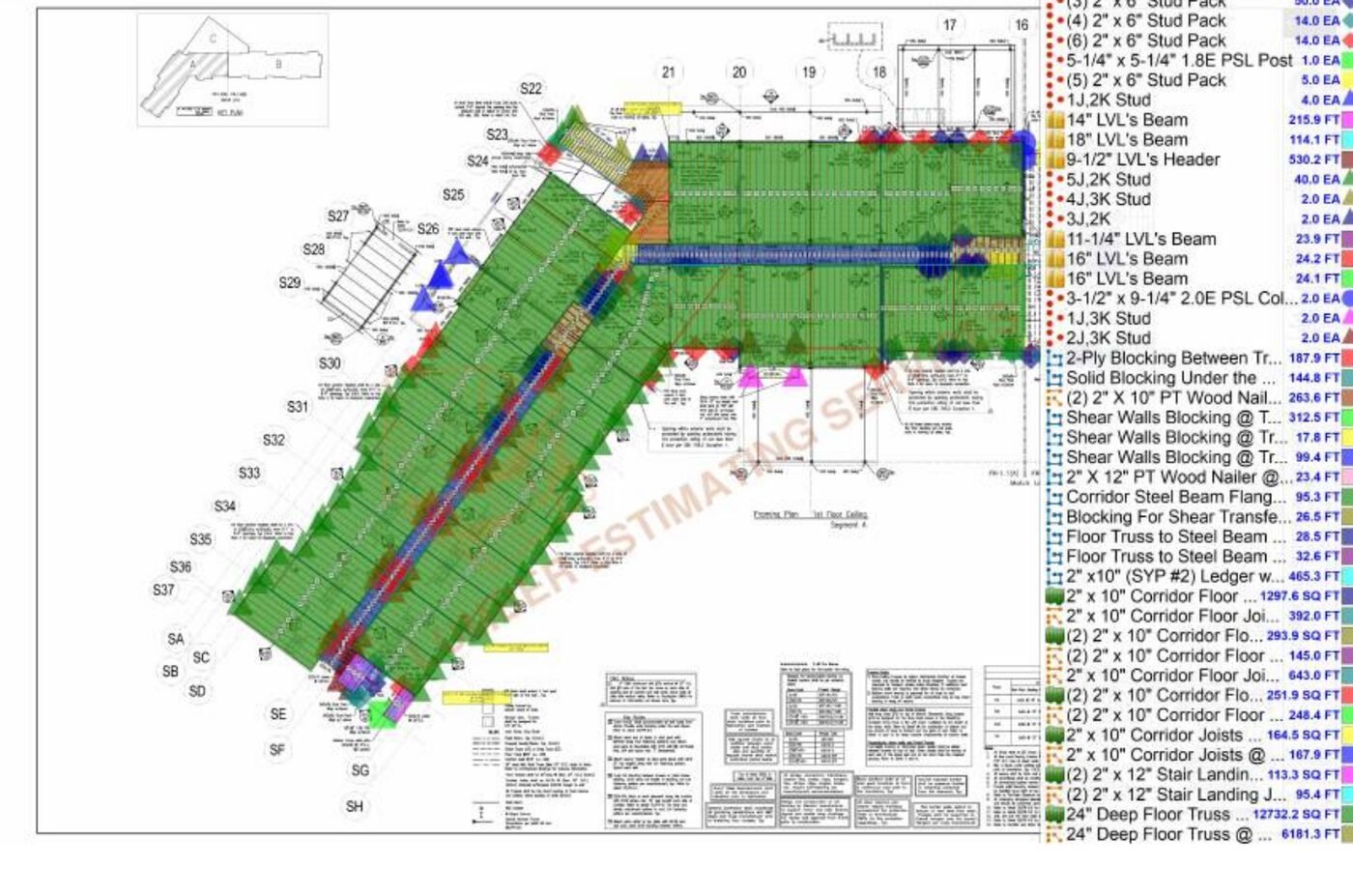
The 12-Month Side-by-Side
| In-House Estimator | Outsourced (per-project or subscription) | |
|---|---|---|
| Annual cost at 120 bids | $95,000–$110,000 | $18,000–$30,000 |
| Cost per takeoff | $790–$915 | $150–$300 |
| Capacity in a crunch week | Fixed — one person’s hours | Scales — a bench absorbs surges |
| Coverage (vacation, turnover) | None | Continuous |
| QC / second set of eyes | Rarely | Built into process |
| Turnaround | 2–5 days when queue is clear | 24–48 hrs residential, 3–5 days commercial |
| Institutional knowledge of your preferences | Excellent | Good with a dedicated coordinator; thin with rotating freelancers |
| Walks plans, visits sites, reads local subs | Yes — irreplaceable | No |
Those last two rows are the honest part, so let’s sit with them.
When Hiring In-House Actually Wins
We’d rather tell you this than have you learn it resentfully later:
- You’re consistently above ~15–20 takeoffs a month and the estimator does more than takeoffs. If the role includes buyout, vendor negotiation, value engineering, site walks, and sub scoping, you’re hiring a preconstruction manager, not a takeoff machine — and that role can’t be outsourced by the sheet.
- Your work is deeply local and relationship-driven. An estimator who knows that a certain lumberyard always shorts 20-footers, or that a certain plan firm’s structural sheets run late, adds judgment no remote service replicates.
- You’re building a preconstruction department deliberately — hiring ahead of growth with the revenue to carry it. That’s strategy, and it’s sound.
The hybrid is often the endgame: an in-house precon lead who manages relationships and strategy, with overflow and commodity takeoffs sent out. Our busiest subscription clients are precisely companies that have estimators — they buy back their senior person’s time by outsourcing the measuring.
When Outsourcing Wins (Most Contractors Under $15M, Frankly)
- You’re the one doing takeoffs now. Your evenings are worth more than $150. Every hour you spend counting studs is an hour not spent winning work or running jobs, and it’s costing you at your rate, not an estimator’s.
- Your bid volume swings. Pay per project and estimating becomes a variable cost that tracks revenue — the way subs and materials already do.
- You’re losing bids to slow turnaround. First accurate bid in often frames the negotiation. Clients using our estimates report bid acceptance improvements up to 34%, and speed is a real part of that.
- You can’t absorb a $95K miss. A bad hire in a one-person department is a year of salary plus a season of bad numbers. A bad outsourced takeoff costs one project fee and a phone call — ours come with free revisions inside 48 hours precisely so that call is easy.
Run Your Own Break-Even
Skip the consultant spreadsheet; it’s three lines.
- Count last year’s real bid volume (be honest — count bids you should have made but skipped for lack of time, too).
- Multiply by $150–$300 (or cap at $18K/yr if volume justifies a dedicated bid manager).
- Compare against $95,000–$110,000 loaded — only if a hire would be fully utilized. If they’d be busy 60% of the time, compare against the full salary anyway, because you pay 100% of it regardless.
For most contractors bidding under 15 jobs a month, the spread lands between $60,000 and $90,000 a year in favor of outsourcing. That funds a superintendent, a truck, or simply margin — your call.
Common Objections, Answered Straight
“An outside estimator doesn’t know my plans like my own guy would.”
True on day one, less true by takeoff five. A dedicated coordinator learns your waste factors, your preferred species, your yard’s stocking lengths — and writes them into a standing spec sheet so they survive personnel changes. Ask any provider how they document client preferences; the answer tells you whether they’ve thought about it. (This is question #7 in our guide to vetting takeoff services.)
“What about accuracy? I can yell at my own employee.”
You can also verify instead of yell. Insist on marked-up plans with every takeoff so quantities are auditable against the drawings — ours ship with color-coded markups as standard, which is exactly what makes the accuracy conversation a math conversation instead of a trust conversation.
“Isn’t outsourcing just a stepping stone until I can afford a hire?”
Sometimes! And that’s fine. Plenty of clients use us for two years, hire a precon manager, and keep us for overflow. Estimating capacity isn’t a loyalty program. Buy it the way you buy any capacity: whatever shape fits this year’s pipeline.
Bottom Line
An in-house estimator is a $95,000–$110,000 annual commitment that makes sense at sustained high volume, especially when the role is really preconstruction management. Outsourced takeoffs deliver the same measured quantities for $150–$300 a project or $1,500 a month flat — a variable cost with built-in redundancy and QC. Run the three-line break-even before you write the job posting.
Easiest way to test the outsourced side of the ledger: send us one live plan set. You’ll have a quote today and a finished takeoff in 24–48 hours — a $150 experiment against a $95,000 decision. Call (332) 242-5480 if you’d rather talk it through.