
A bad takeoff never announces itself in the quote. The quote is where it hides best — a clean number, a fast promise, a professional-looking PDF. The tells are there, though, and they’re consistent enough that after reviewing hundreds of competitor takeoffs contractors have sent us over the years (“can you check this?”), we can usually predict the jobsite problem from the quote alone.
Here are the nine flags, roughly in order of how much they should scare you.
Flag #1: A firm price before anyone opened your plans
Complexity lives in the drawings — plate heights, roof cuts, shear schedules. A provider quoting a firm number sight-unseen is doing one of two things: padding every quote to cover the unknowns (you overpay on simple work), or planning to “discover” complexity after you’ve committed (the flat price was bait). Either way, the pricing isn’t about your project. A real quote takes plans first and a few hours after; ours are free and usually same-day.
Flag #2: No plan markups in the deliverable
The single most reliable flag. If quantities arrive as a spreadsheet with no color-coded plan markups behind them, the numbers are unverifiable — by you, by your yard, by anyone. You cannot audit what you cannot trace. Some low-cost operations skip markups precisely because markups expose shortcuts; a measured takeoff produces them almost as a byproduct. No markups, no order.
Flag #3: “Allowance” where counts should be
“Hardware allowance: $1,800.” “Blocking: allowance.” An allowance line in a takeoff is an estimator billing you for not estimating. On one commercial project we produced, hardware alone came to 23,578 sheathing clips and 4,046 boxes of fasteners across 18 types — countable items that got counted. Allowances belong in early budgets, not in a deliverable you paid to have measured. Every allowance line is a jobsite surprise with a delivery date TBD; the compounding cost of those surprises is documented in The True Cost of a Bad Lumber Takeoff.
Flag #4: Lump-sum line items
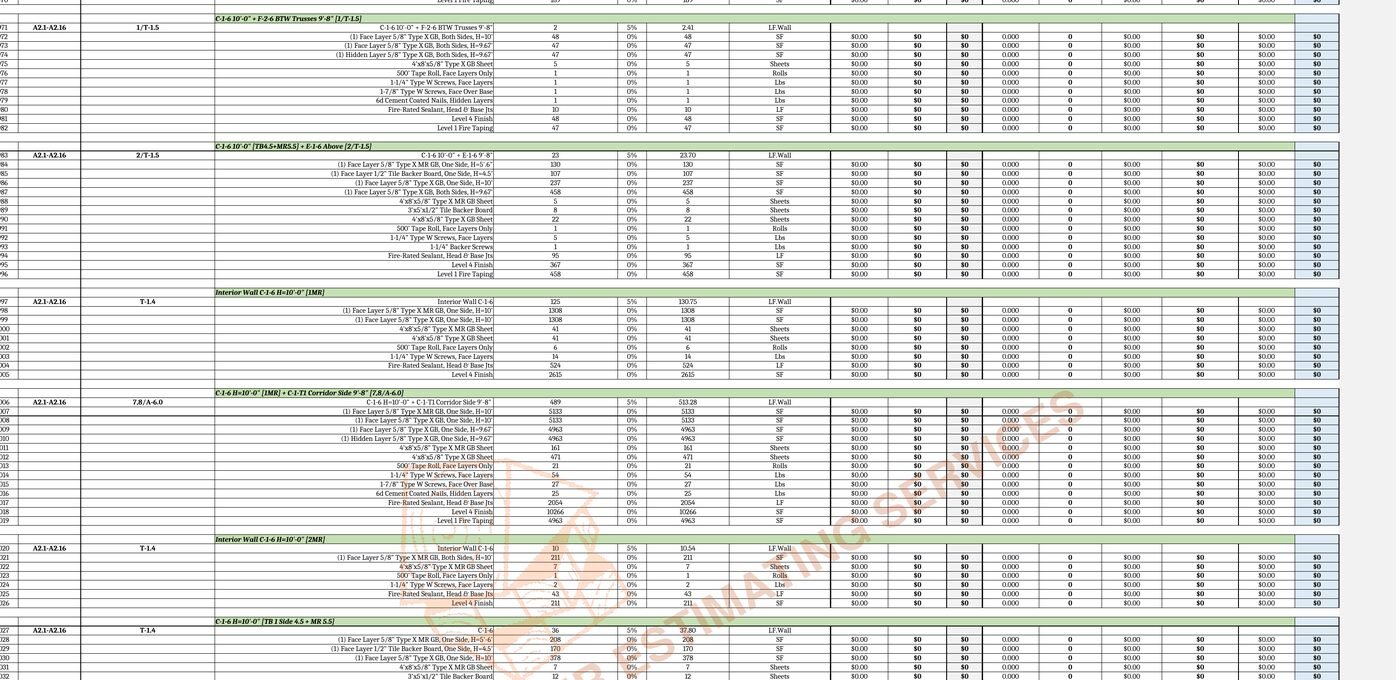
“Framing lumber — 1 lot.” “Beams — misc.” Lumps are where misses hide, because a lump can’t be checked against anything. The standard you want reads like a yard order: 6×12 DF #2 @ 12′ — 73 pcs. If the provider’s sample doesn’t show that grain of detail, the sample is the ceiling, not the floor, of what you’ll receive.
Flag #5: No waste factor visible anywhere
Two failure modes, same flag. Either waste wasn’t applied (your order comes up short on every cut-heavy material) or it’s baked invisibly into the counts (you can’t tune it, audit it, or stop it from inflating every bid). Industry practice is 10–15% varied by material, shown as its own line. “It’s built in” is not a rate; it’s a shrug.
Flag #6: Vague turnaround, no revision policy
“Usually 2–3 days” against your hard bid date; silence about what happens when Addendum 2 lands. Plans change on essentially every real project — a provider with no written revision policy either hasn’t handled live bid cycles or handles them by improvising an invoice. Market standard: stated turnaround (24–48 hrs residential, 3–5 days commercial), rush at a stated +25–35%, and a defined revision window (ours: free within 48 hours of delivery).
Flag #7: Only a locked PDF
If you can’t sort it, filter it, re-price it, or send it to your lumberyard as a working file, you own a screenshot. Editable Excel/CSV plus PDF is the standard, and there’s no legitimate operational reason to withhold it — the only thing a locked file protects is the provider from scrutiny.
Flag #8: The price can’t survive its own arithmetic
Some quotes fail math class. A genuinely measured single-family takeoff — walls, floors, roof, sheathing, hardware, with QC review and markups — represents hours of skilled work. At $49, either hours or skill has been removed: pure software output with no review, an area-formula guess dressed as a takeoff, or a loss-leader whose real price appears in scope-gap invoices later. Cheap and honest exists (efficient shops, offshore labor rates — more on that below). Cheap beyond arithmetic doesn’t. When a price is a fraction of everyone else’s, the missing money is coming out of your jobsite. The full market range is in our pricing breakdown; anything at a third of the bottom of it deserves the questions in our vetting guide.
Flag #9: Accuracy bluster with nothing behind it
“100% accurate, guaranteed” is a claim nobody who measures for a living makes with a straight face. Serious providers state accuracy with a definition attached — what’s measured, against what baseline, verified how — and back it with markups and a correction process. (We publish 98%, and we explain exactly what that means and doesn’t in Is 98% Accuracy Real?.) A provider who won’t explain their number is asking you to bid other people’s money on vibes.
A Note on Offshore Estimators, Since Someone’s Wondering
Plenty of takeoff work is performed overseas, including by excellent estimators — and plenty of bad takeoffs are produced domestically at premium prices. Geography isn’t the flag. Process is. A team anywhere on earth that delivers line items, markups, stated waste, QC review, and a real revision policy will beat a solo shortcut-taker in your own zip code every time. Ask the nine questions above; the passport doesn’t answer any of them.
The 60-Second Quote Screen
Before you commit to any provider, one pass:
- Did they see plans before pricing?
- Markups included — confirmed in writing?
- Sample shows line items, not lumps?
- Zero “allowance” lines in a measured scope?
- Waste stated as visible percentages?
- Turnaround is a date; revisions have a policy; rush has a number?
- Editable file delivery?
- Price explainable by hours of skilled work?
- Accuracy claim comes with a definition?
Nine yes answers and you’ve probably found a keeper — at any price point. Two or more no’s and the cheap quote has already told you exactly where it’s going to cost you.
Run us through the screen: full sample takeoff here, quotes from real plans within hours, markups with every job, from $150. Upload plans or call (332) 242-5480.