
As of early September 2026, the framing lumber composite tracked by NAHB (Madison’s Lumber Price Index) sits at $516 per thousand board feet — down 1.6% on the week, the third straight weekly decline after nearly three months of rising prices, but still up 8.4% from a year ago. Lumber futures are trading near $568/MBF. In plain framing terms: lumber is cooling off a summer run-up, and it’s still meaningfully more expensive than it was this time last year.
That’s the snapshot. But if you bid framing work or buy wood packages, the number itself matters less than what you do with it. This post covers where prices stand, the three forces actually moving them, and — the part most price commentary skips — how estimators and framers protect margin while the market moves under their feet.
Where Framing Lumber Prices Stand (September 2026)
- Framing lumber composite: ~$516/MBF (week of September 18, 2026), −1.6% week-over-week, +8.4% year-over-year, after peaking through a summer rally.
- Lumber futures (CME): ~$568/MBF in the first week of September, down about 2% over the month, up roughly 6% on the year.
- The translation for a bid: at ~$516/MBF, the raw dimensional lumber in a typical 2,000 SF house (~14,000–16,000 BF with waste) runs roughly $7,300–$8,300 — hundreds of dollars different from a bid priced off spring numbers, on a single house.
Composite indexes blend species and regions; your yard quote reflects your region, rail costs and dealer position, and routinely sits 10–20% off the index in either direction. The index tells you the direction and speed of the market. Your quote tells you your price. Confusing the two is how bids age badly.
The Three Forces Moving Prices This Year
1. Duties and tariffs on Canadian lumber. Canada supplies a large share of U.S. framing lumber, and combined antidumping and countervailing duties reached roughly 35% in 2025–26 — a floor under U.S. prices regardless of demand. Preliminary determinations announced in 2026 point toward a lower combined rate (mid-20s) after the next administrative review, which is one reason forward prices have softened; if the cut lands, expect it in dealer quotes with a lag, not overnight.
2. Mill capacity discipline. Producers have spent two years curtailing and idling capacity in response to weak single-family starts. Supply now tightens fast whenever demand blips — which is exactly what the May–August rally looked like, and why rallies in this market run hot then fade as curtailed capacity restarts.
3. Housing demand. Single-family starts remain the demand anchor. Softer starts through 2026 have capped how far rallies run — but multi-family and hotel wood framing (the mid-rise Type III/V work we estimate weekly) keeps regional demand for studs, trusses and panels firmer than the headline starts number suggests.
What Price Volatility Actually Does to a Framing Bid
A 10% composite move on a $15,000 house package is $1,500. On the commercial side it scales brutally: the 84,206 SF hotel we took off in Brentwood carried tens of thousands of pieces of dimensional lumber — at that scale, a summer’s price run is the difference between a profitable framing package and a painful one, purely on timing.
And here’s the estimator’s core point: price risk and quantity risk are different risks, and only one of them is your choice. The market moves whether you like it or not. Your quantities are either right or wrong before you ever pick up a price sheet — and a 6% quantity miss costs the same margin as a 6% price rally, except you paid for one of them yourself. We’ve priced out that failure mode in the true cost of a bad lumber takeoff.
Six Ways Framers and GCs Protect Margin in a Moving Market
- Put a validity window on every quote. “Price good for 15 days” is standard practice in volatile stretches; open-ended lumber pricing is a free option you’re granting the buyer.
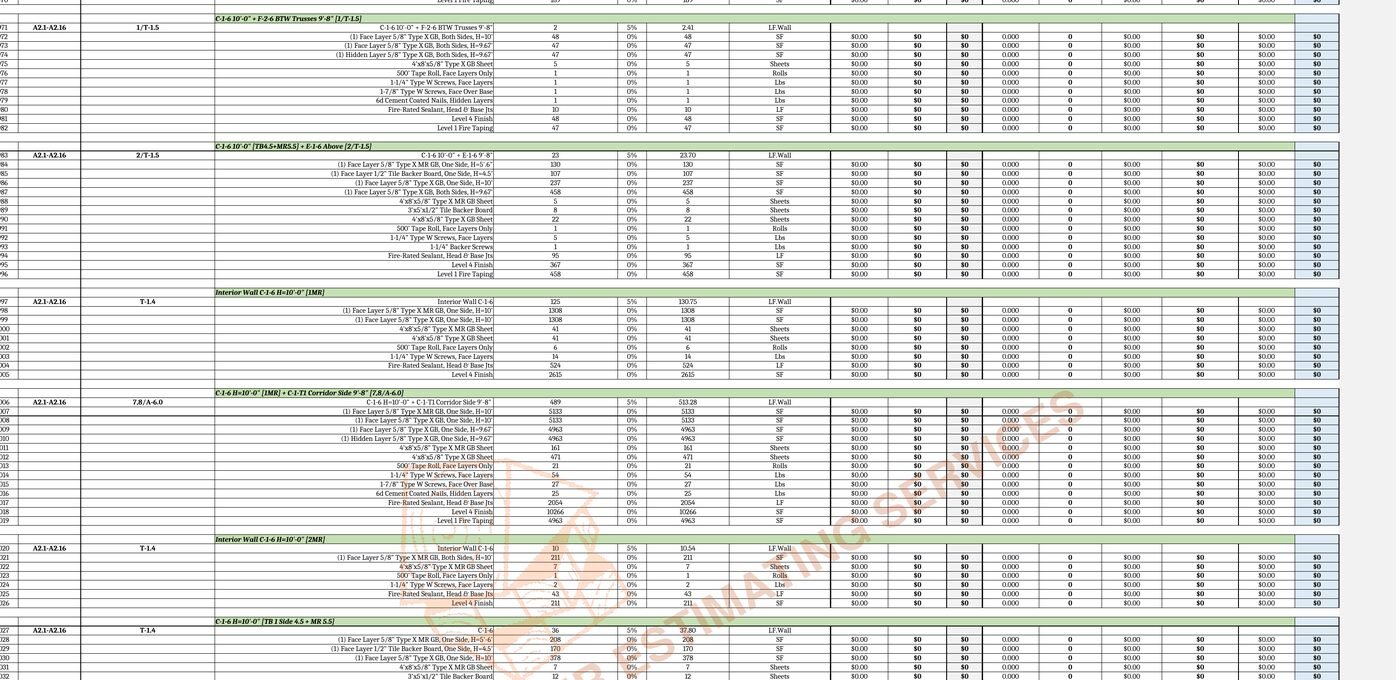
- Separate quantities from pricing. Keep the takeoff as a live document with unit-price columns. When the composite moves 5%, you re-price in minutes instead of re-measuring anything. (Every takeoff we deliver is built this way — quantities, waste, and pricing columns you drop your yard’s numbers into.)
- Get two yard quotes on the same bill of materials. Dealers reposition inventory at different speeds in a moving market; an identical BOM quoted twice is the cheapest price discovery there is — and it only works if the BOM is itemized enough to quote without interpretation.
- Use a cut list to buy fewer board feet. Mapping cut lengths into efficient stock lengths trims real percentage points off the order — savings that get bigger, not smaller, when prices are high.
- Time engineered lumber separately. LVL, PSL and glulam move on different dynamics than dimensional SPF/DF; don’t let a dimensional rally panic you into early buys of the engineered package, or vice versa.
- Watch the weekly composite, act on your quote. NAHB publishes the composite weekly; it’s the early-warning system. The trigger for action is your dealer’s number on your BOM.
Where Prices Go from Here
Nobody who frames buildings for a living should pretend to know the next print — we certainly don’t. The observable setup into fall 2026: a cooling composite ($516 and easing), futures holding a premium to cash (the market pricing in duty relief and eventual demand recovery), duty rates likely heading down, and mill discipline that will meet any demand surprise with fast price response. Both directions are live. Which is exactly the argument for the one thing you control completely: exact quantities, visible waste, and a package you can re-price the morning the market moves. Deeper cost benchmarks live in lumber cost per square foot for framing and how much lumber it takes to frame a house.
Bidding into this market? Send your plans for a fixed-price takeoff — from $150, delivered in 24–48 hours with pricing columns ready for your yard’s current numbers. (332) 242-5480.