
Here’s the short answer, since most pricing pages make you dig for it: a professional lumber takeoff for a single-family home typically runs $150 to $500 in 2026. Commercial and multifamily takeoffs start around $300 and scale with square footage and scope. Monthly estimating subscriptions — where a dedicated estimator handles all of your bids — run $1,000 to $2,500 per month.
That’s the market. The longer answer is more useful, because two takeoffs with the same price tag can be wildly different products. One is a stud count scribbled off a floor plan. The other is a procurement-ready bill of materials that a lumberyard can price line by line without calling you once. This guide breaks down what you should actually pay, what moves the number, and where paying less costs you more.
Lumber Takeoff Pricing in 2026: The Quick Reference Table
| Project Type | Typical Price Range | Turnaround |
|---|---|---|
| Single-family home (up to ~3,500 sq ft) | $150 – $500 | 24–48 hours |
| Custom home / complex roof & framing | $300 – $800 | 2–3 days |
| Townhome / small multifamily | $500 – $1,500 | 3–5 days |
| Commercial & industrial (up to ~12,000 sq ft) | $300 – $2,000+ | 3–5 days |
| Hotel / large multifamily (per building) | $1,500 – $5,000+ | 5–10 days |
| Dedicated bid manager (subscription) | $1,000 – $2,500 / month | Ongoing |
| Rush delivery (under 24 hours) | +25–35% surcharge | Same / next day |
For reference, our own pricing at Lumber Estimating Services starts at $150 for a full single-family framing takeoff and $300 for commercial projects up to 12,000 square feet, with rush delivery available at a 30% surcharge. Free revisions are included within 48 hours of delivery. You can see a complete sample takeoff here before spending anything.
What Actually Drives the Price of a Lumber Takeoff
1. Square footage — but less than you’d think
Square footage matters, but it isn’t linear. A 4,800 sq ft rectangle with a simple gable roof takes less estimating time than a 2,600 sq ft custom home with three roof pitches, vaulted ceilings, and a cantilevered deck. Estimators price on measurable complexity, not floor area alone. If your plans are clean and repetitive, you’re on the cheap end of the range even at higher square footage.
2. Scope: framing-only vs. full material list
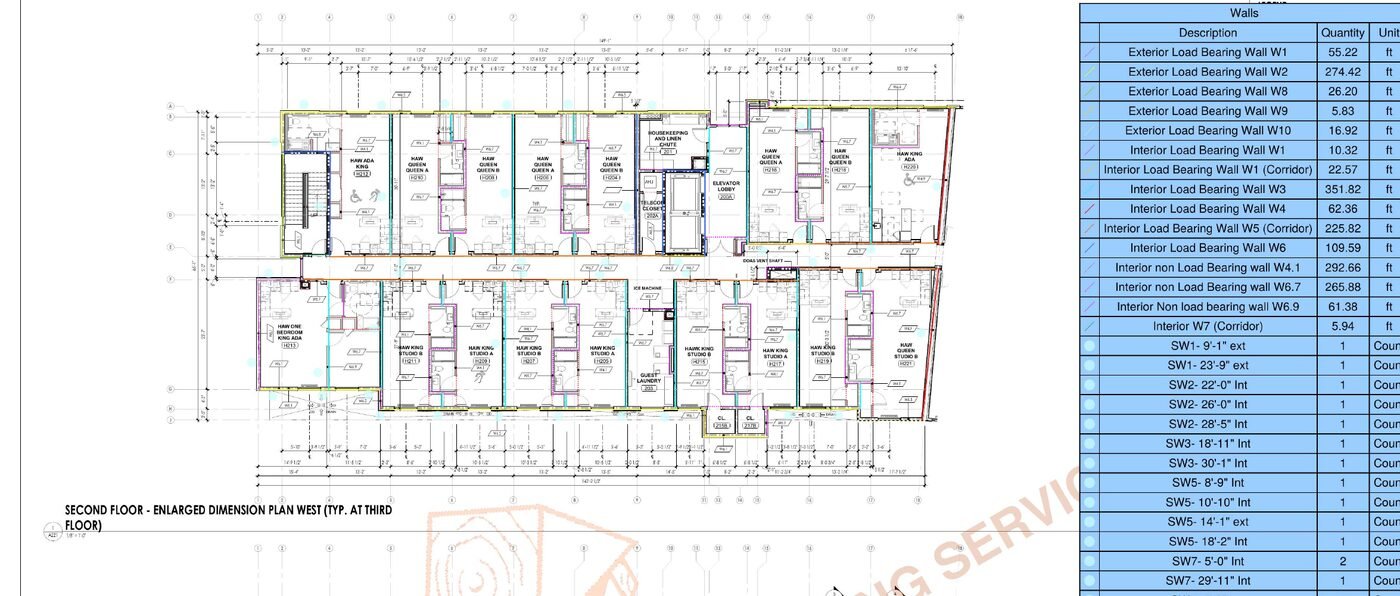
A framing-only takeoff (studs, plates, headers, joists, rafters, sheathing) is the baseline product. Every scope you add — roof framing, siding, decking, millwork and trim, hardware and fasteners — adds estimating hours. On a recent skilled nursing facility takeoff we produced, the fastener schedule alone ran to 4,046 boxes across 18 nail and screw types, plus 23,578 sheathing clips. Counting that properly is real work, and it’s the difference between a bid you can defend and a bid with a hole in it.
3. Plan quality
Clean, dimensioned PDF or CAD plans price at the bottom of the range. Scanned paper drawings, missing structural sheets, or plans mid-revision push the price up because the estimator has to reconcile gaps. If you want to save money on takeoffs, the cheapest lever you control is sending complete plan sets: architectural, structural, and shear wall schedules together.
4. Deliverable format and pricing detail
A quantity list is one price. A bill of materials organized by floor level and framing phase, with species and grade callouts, NAHB-standard waste factors (typically 10–15%), and current market pricing applied — that’s a bigger product. As of August 2026, the Random Lengths framing lumber composite sits at $558 per thousand board feet, up 2.1% month over month, and a takeoff that prices your package at current numbers rather than spring numbers protects your margin on every bid.
5. Turnaround
Standard delivery is 24–48 hours for residential and 3–5 business days for larger commercial work. If a bid closes tomorrow, rush service exists — expect a 25–35% premium for it. A word of advice from the other side of the desk: contractors who send plans the day they receive an ITB almost never pay rush fees. The surcharge is really a procrastination tax.
What a Professional Takeoff Should Include at These Prices
If you’re paying $150 or more, you should receive every item on this list. If a provider can’t confirm all of them before you order, keep shopping.
- Itemized lumber list with sizes, lengths, species, and grade (e.g., 6×12 DF #2 @ 12′, not “beams — misc.”)
- Counts organized by floor level, roof section, or construction phase
- Sheathing and panel counts by thickness and rating
- Engineered wood itemized separately: LVL, glulam, I-joists, floor trusses with spans
- Waste factors shown transparently, not buried in inflated counts
- Hardware and fastener schedule if scoped
- Editable Excel or CSV delivery plus PDF — not a locked PDF only
- Marked-up plans showing what was measured, so quantities are verifiable
That last point matters more than any other. When a lumberyard questions your order, or a framer claims a shortage mid-job, color-coded plan markups let you resolve the dispute in minutes. We cover the full deliverable standard in our lumber takeoff deliverables checklist.
Real Numbers: What Takeoffs Cost vs. What They Return
A typical 2,200–2,500 sq ft home uses roughly 14,000–16,000 board feet of lumber. At today’s composite price, the framing lumber package alone runs $6,800–$7,800, and total wood products (lumber, panels, engineered wood, trusses) commonly land between $12,000 and $18,000 per house.
Against that package, a $150–$300 takeoff fee is 1–2% of your lumber spend. Now look at the two failure modes it protects you from:
- Over-ordering. Pad your counts “to be safe” by even 7% and you’ve buried $850–$1,250 per house in material that ends up in the dumpster or the yard return pile — if the yard takes returns at all.
- Under-counting. Miss quantities and you’re buying mid-job at spot prices, eating rush delivery fees, and paying framers to stand around. This failure mode is worse, and we wrote up exactly how it compounds in The True Cost of a Bad Lumber Takeoff.
Contractors who bid from professional estimates also win more work — across our own client base we see bid acceptance improve by as much as 34% once contractors start submitting faster, tighter numbers. Whether your number is 34% or 10%, the direction is the same: precise bids read as competence, and buyers can tell.
How Per-Project Pricing Compares to the Alternatives
| Option | Real Annual Cost (20–30 bids/yr) | Hidden Cost |
|---|---|---|
| Doing takeoffs yourself | “Free” | 10–20 unpaid hours per bid, evenings and weekends |
| Takeoff software license | $1,500–$3,000/yr + learning curve | You’re still the one doing the takeoff |
| Full-time estimator | $65,000–$95,000 + software + benefits | Idle capacity between bids |
| Outsourced per-project | $3,000–$12,000/yr | None meaningful at this volume |
The break-even math between hiring and outsourcing deserves its own article, and it has one: In-House Estimator vs. Outsourced Takeoffs: A 12-Month Cost Comparison. The short version: below roughly 15–20 bids per month, a salaried estimator is idle capacity you’re paying for year-round.
Questions Contractors Ask Us About Pricing
Why do some providers advertise takeoffs for $99 or less?
Usually one of three reasons: the price excludes scopes you’ll be charged for later, the “takeoff” is a software-generated area calculation with minimal human review, or the provider is buying market share and the turnaround/revision support won’t hold up. Cheap takeoffs aren’t a scandal — they’re just a different product. Know which one you’re buying. Our guide to red flags in takeoff quotes shows how to tell the difference in one phone call.
Do I pay more for priced takeoffs vs. quantity-only?
Sometimes, modestly. Quantity-only suits contractors with strong yard relationships who price their own lists. Priced takeoffs suit anyone bidding competitively in a moving market — and with lumber up 2.1% in the past month, the market is moving.
Is a monthly subscription worth it?
If you bid weekly, yes. Our Virtual Bid Manager runs $1,500/month for a dedicated coordinator handling every bid in your pipeline. At 8+ takeoffs a month it beats per-project pricing on cost alone, before counting the consistency benefit of one estimator learning your preferences.
What do you need from me to quote a price?
Just the plans — PDF, DWG, DXF, Revit, or even scanned drawings — and your scope. You’ll have a fixed quote before any work starts. Send plans here or call (332) 242-5480; quotes are free and take a few hours, not days.
The Bottom Line
In 2026, expect to pay $150–$500 for a residential lumber takeoff, $300–$2,000+ for commercial, and $1,000–$2,500/month for dedicated estimating support. Price the service against the $12,000–$18,000 wood package it’s protecting and the unpaid evenings it’s giving back to you — not against the cheapest number on page two of Google.
Want an exact number instead of a range? Upload your plans and we’ll quote your project free — most quotes go out same day, and finished takeoffs land in 24–48 hours.